Reaching customers in their native language has evolved from an advantage in ecommerce to a necessity. Shoppers are more likely to purchase from brands that speak to them in a familiar way.
While many businesses understand the value of localized storefronts, they often overlook a critical component: the product feed. Optimizing feeds for each market has historically been a manual, time-consuming process. It then creates a significant bottleneck for global expansion.
This is where our native AI feed optimization changes the game. It offers a scalable way to achieve local relevance without sacrificing speed.
We’ve expanded our native AI feed optimization to 10 languages, designed to help you connect with more customers and grow your business internationally.
We'll explore how this development makes advanced feed management more accessible and effective for everyone.
- Discover the ten languages now supported by our AI-driven feed optimization tools.
- The power of optimization: Understand how well-optimized product feeds drive better performance and visibility on advertising platforms.
- Our AI-powered feed optimization has already transformed the way advertisers work. See real-world results and case studies from businesses using DataFeedWatch AI for feed optimization.
- There are benefits for everyone. Learn how this feature helps agencies, international brands, and local sellers improve efficiency and results.
What’s new: AI-powered feed optimization in 10 languages with DataFeedWatch
DataFeedWatch’s native AI feed optimization now supports 10 languages:
- Danish
- Dutch
- English
- French
- German
- Italian
- Norwegian
- Polish
- Spanish
- Swedish
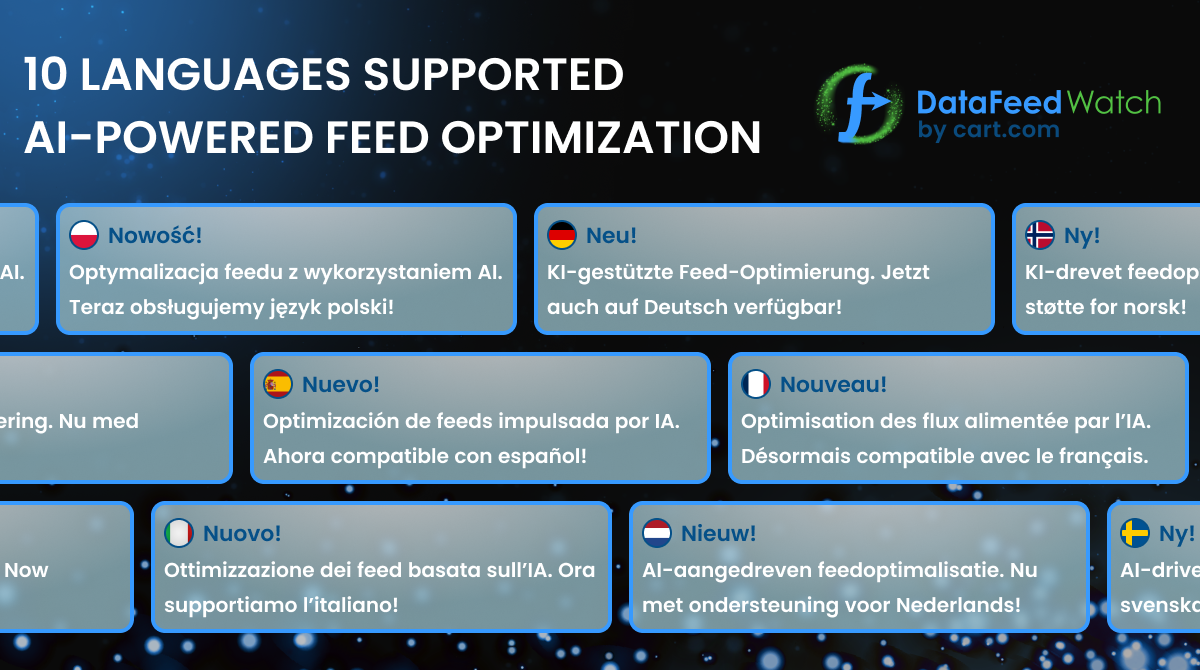
Our integrated AI is designed to understand and apply the unique nuances of each market. It was trained on language-specific and channel best practices for creating optimized product data.
That means when you connect your product feed, it will automatically be transformed into:
- Product titles that hit all the right notes for what type of product you’re selling
- Product descriptions that help sell your products
- Accurate product categorizations based on Google’s taxonomy
- Populated size and color attributes that may have been missing before
New AI features
We’ve also expanded our AI functionalities with new attributes and supported channels.
Attributes
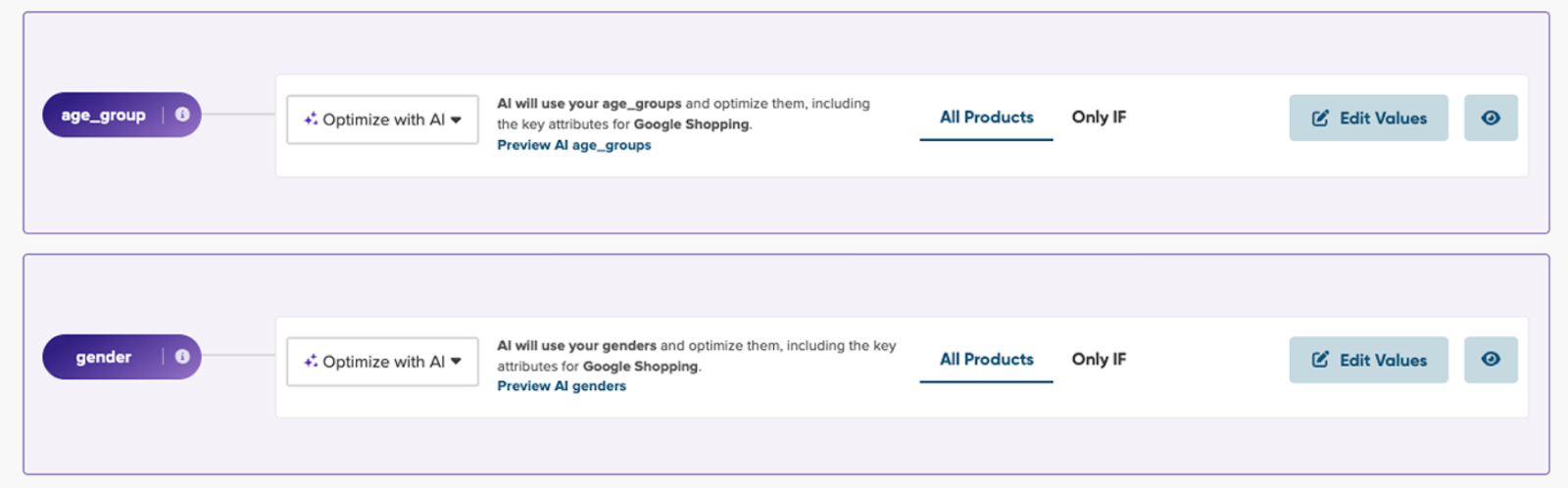
You can now have the ‘Gender’ and ‘Age group’ attributes automatically filled in when mapping your feed.
Channels
Scale your multi-channel advertising strategy with AI-powered feed optimization for these channels:
- Snapchat
- Bing
- TikTok

The power of your data: why optimized feeds are non-negotiable
Having your product feed localized for the country you’re selling in is the first step to successful paid search campaigns.
However, your product data also needs to be finely tuned for performance. This is where optimized product feeds become a defining factor in a successful advertising campaign.
When product feeds are thoroughly optimized, they go beyond just listing basic information. This attention to detail builds trust and signals to customers that your brand is professional and reliable. The result is higher ad relevance, improved click-through rates (CTRs), and a stronger Quality Score on platforms like Google Shopping.
The age of AI-based campaign algorithms
The need for optimized product feeds is becoming even more relevant with the increase of AI-powered campaigns like Google’s PMax and AI Max for Search. These kinds of campaigns give advertisers less control over the levers that determine when a product is shown to a shopper. But one thing advertisers will always have control over is the quality of their product data.
The pitfalls of a one-size-fits-all approach
What happens when you neglect optimization? Advertisers who rely on a single, generic product feed across multiple countries often face significant hurdles.
The most immediate challenge is poor ad performance. Ads with incomplete, unclear, or poorly structured product titles and descriptions fail to capture user attention. This leads to low engagement and wasted ad spend.
Beyond performance issues, there's the operational burden. Manually optimizing feeds for each new market is a monumental task. It demands a deep understanding of varying market trends, SEO best practices, and the unique requirements of every advertising channel. Not to mention, if you’re missing data for required attributes, you’ll need to manually go through the product feed to find them.
For marketing teams and agencies, this means countless hours dedicated to tedious, repetitive work that could be better spent on high-level strategy and creative campaigns. This manual effort is also prone to human error, which can lead to disapproved products or inaccurate listings that damage brand credibility.
This is precisely where AI can lift the heaviest burdens.
How DataFeedWatch’s AI transforms global feed management
We automate the process of optimizing your product data for different markets and channels.
Our AI-powered tool is built to handle the most critical and time-consuming aspects of feed management. It provides a suite of features that work together to ensure your product data is complete, consistent, and structured for maximum performance across all your advertising channels.
You also remain in control of what product data is sent to the channels you’re advertising on with the ability to edit any of the AI-generated values.
Here is a breakdown of how product data is optimized:
Optimizing product titles
Product titles are arguably the most important element of your product listing, apart from images. They are often the first thing a potential customer sees and play a huge role in ad relevance and click-through rates. Creating effective titles manually, especially for large catalogs, is a major challenge.
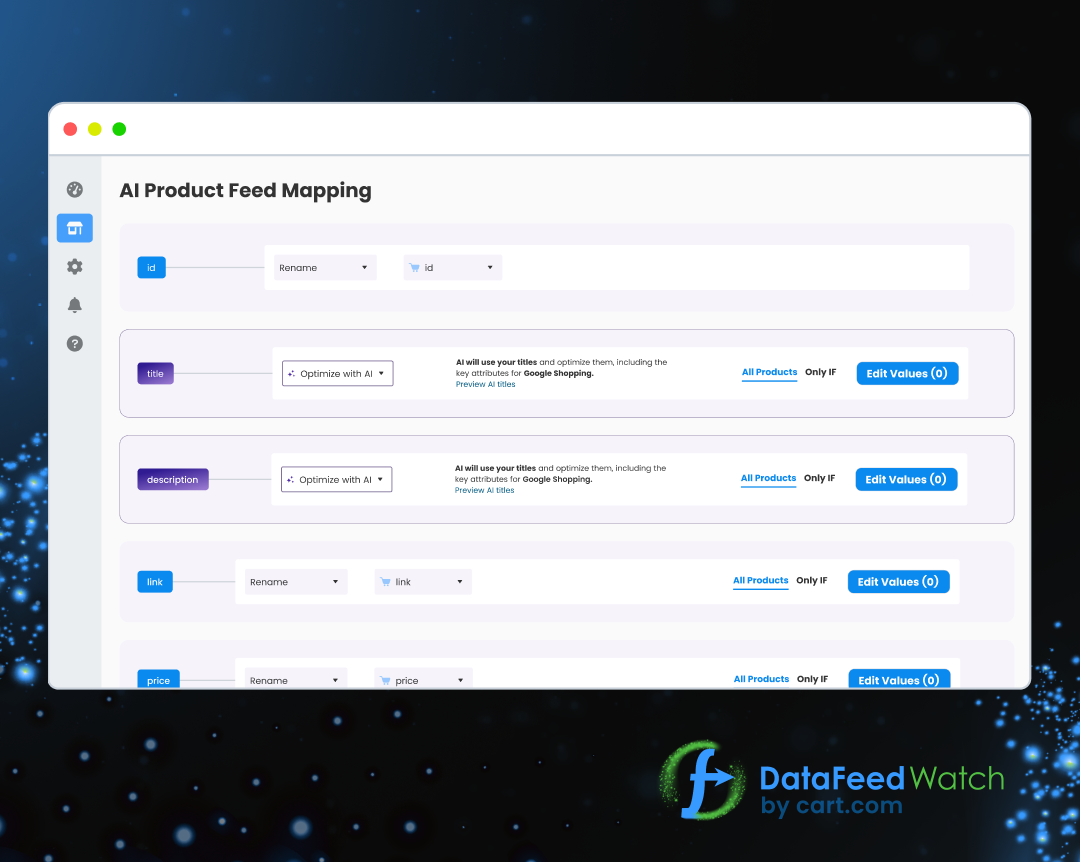
Our AI automates this process by restructuring your titles according to proven, high-impact formulas. It can intelligently identify and arrange key elements like brand, product type, gender, color, and size to create a title that is both descriptive for the customer and optimized for channel algorithms. This ensures your products show up for the most relevant searches, improving visibility and attracting more qualified buyers.
Enhancing product descriptions
While titles grab attention, product descriptions seal the deal. They provide the necessary details that help a shopper make an informed purchasing decision. However, writing compelling descriptions for every single product is often impractical.
The AI feature can enhance your existing descriptions by identifying and highlighting key features and benefits that may be buried in unstructured text. It helps ensure that crucial information is presented clearly and effectively, improving the overall quality of your listings and giving customers the confidence to make a purchase.
Filling in missing attributes
Incomplete product data is a common problem that leads to disapproved ads and poor campaign performance. Attributes like color and size are not just important for filtering; they are often required by advertising channels like Google Shopping. Manually finding and adding this information for thousands of products is an enormous task.
Our AI tool scans your product data to find and extract this missing information automatically for:
- Color
- Size
- Age_group
- Gender
For example, if a title says "Men's Blue T-Shirt, Large," the AI can identify "Blue" as the color and "Large" as the size, then populate the corresponding attribute fields in your feed. This function helps ensure your feed is complete and compliant, preventing errors and maximizing your product visibility.
Automating product categorization
Placing your products in the correct category is essential for advertising success. Channels use this information to understand what you're selling and match your ads to relevant user searches. However, manually mapping each of your products to a channel’s specific taxonomy, like the Google Product Taxonomy, is complex and tedious.
The AI simplifies this by automatically assigning the most accurate category to each of your products. By analyzing your product titles, descriptions, and other data, it intelligently matches your items to the correct category. This saves hours of manual work and improves the accuracy of your listings, leading to better ad targeting and overall campaign performance.
Tailored for success: how DataFeedWatch AI benefits every type of seller
Whether you're an agency managing diverse client accounts, a local retailer aiming to improve your digital reach, or a global brand operating across borders, our AI-powered feed optimization was built for you.
What does this look like in the real world?
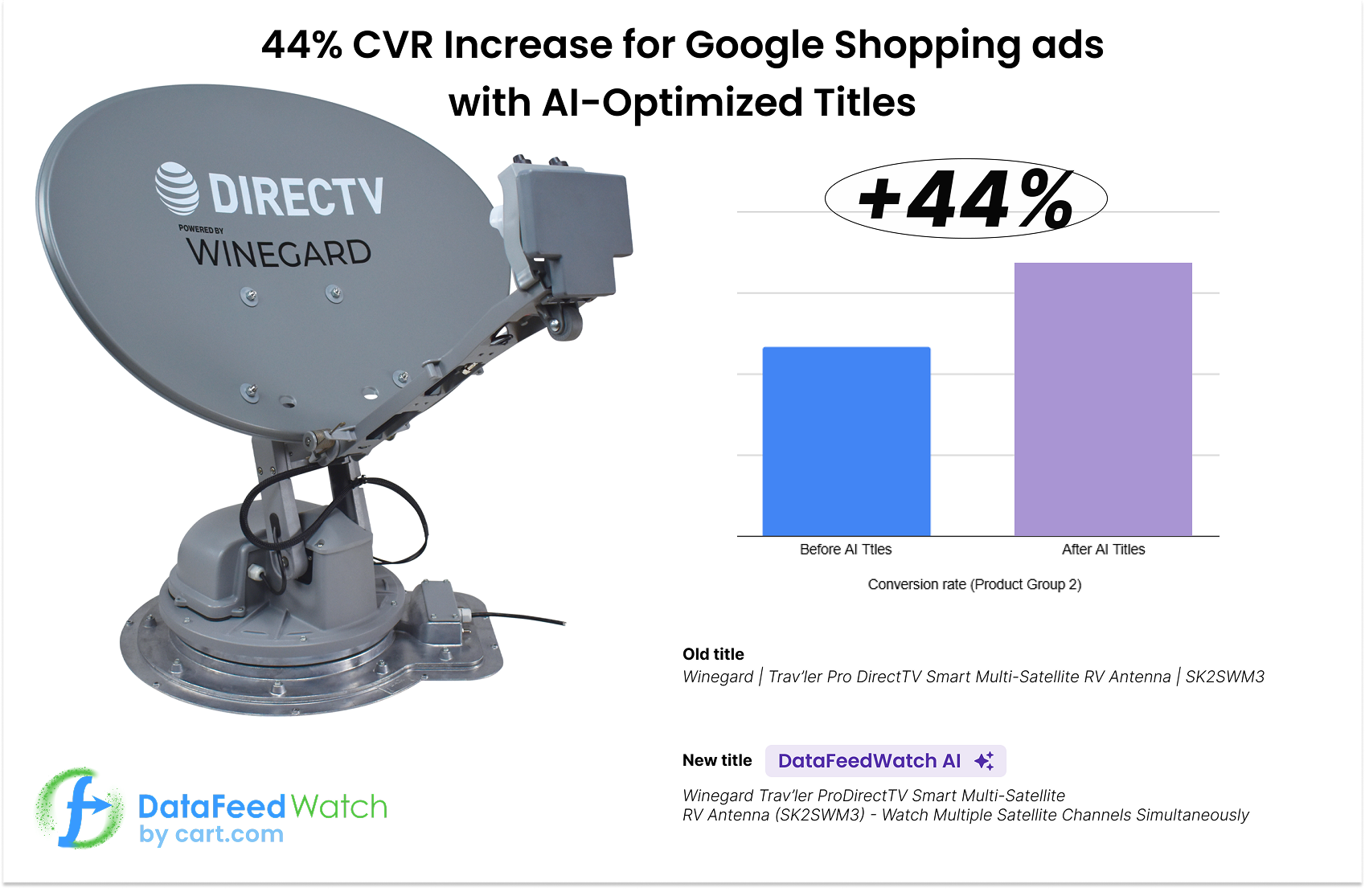
A DataFeedWatch client had a one-man PPC team. They were low on resources, but knew the importance of optimizing their product feed. They tested out using AI optimization for their product titles and descriptions with a few products.
After testing the before and after results, they saw that their conversion rate went up by 17% and 44%.
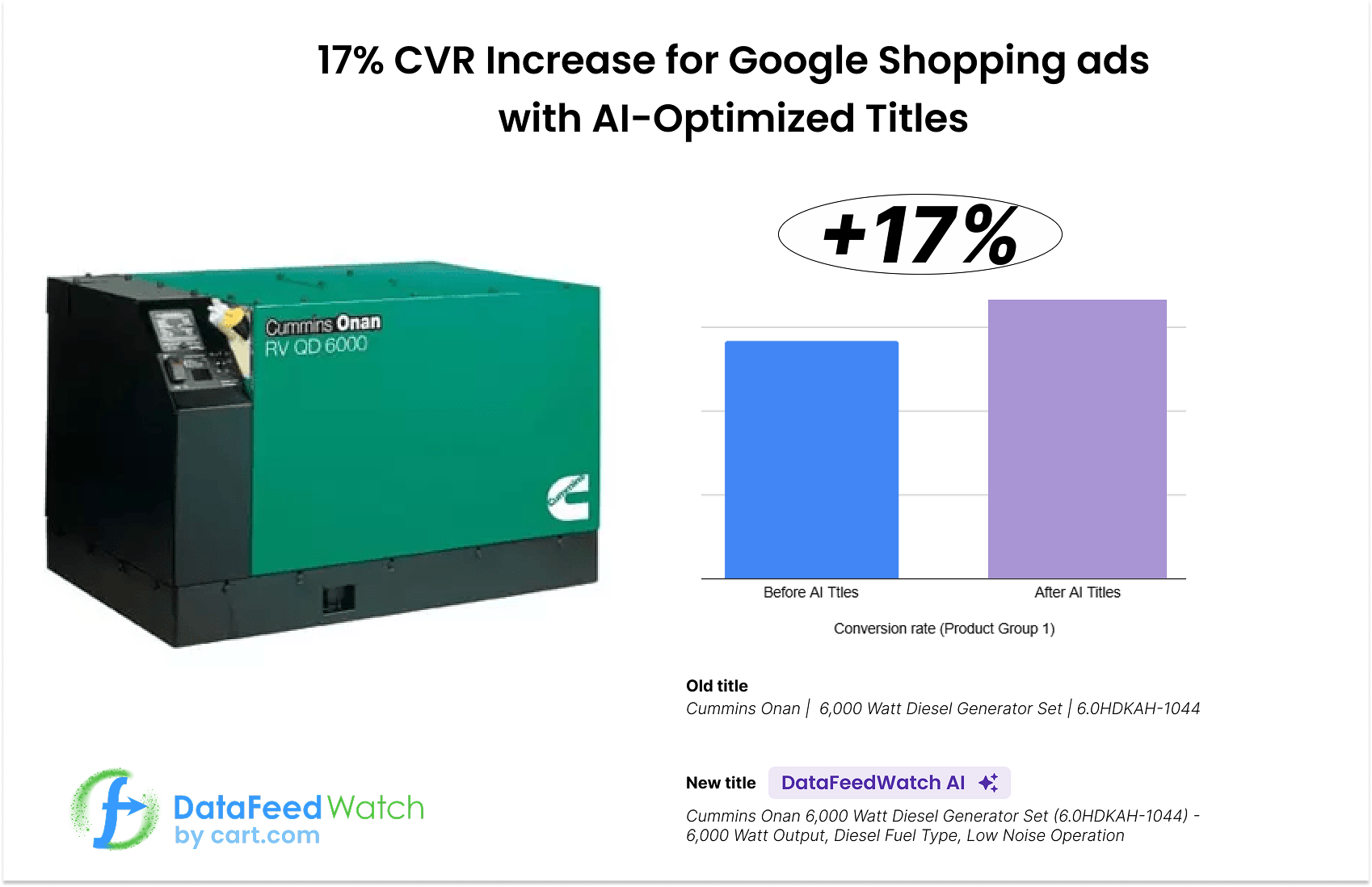
After that they decided to apply the same strategy across all of their feeds, and saw similar results following the change.
Digital advertising agencies also have found the AI useful for their clients. Jonatan Johansson, CEO at digital agency Est Populo, commented on how DataFeedWatch AI has helped their agency.
"As an online marketing agency, we have a lot of spinning plates and our customers expect top quality results. DataFeedWatch’s native AI lets us deliver these results even faster - freeing up time and mental space for other high-priority tasks.
Creating and optimizing product feeds is a task that’s quite time-consuming and technical. But we can use DataFeedWatch's embedded AI to alchemize scattered product data into a finished feed with the click of a button.
We no longer need to spend hours on things like title and description optimization, or finding missing data for thousands of products across dozens of product categories, making it the perfect fit for us."
Let’s break down what this might look like for you, depending on your place in the PPC world.
For agencies with multilingual clients
Managing product feeds for clients across different countries involves a distinct set of optimization challenges. Agencies must ensure each feed meets the requirements and best practices of multiple markets. These often vary in structure, attribute importance, and channel guidelines.
Navigating these differences can be time-consuming and mentally demanding for account managers who are balancing several client accounts, each with its own set of optimization needs.
This changes with our AI.
Simplified multilingual feed management:
Instead of manually editing feeds to meet the specific optimization requirements for different countries, account managers can now rely on intelligent, automated optimizations with just a few clicks.
Our AI applies best practices for feed structure and attribute inclusion, ensuring that every product feed is tailored to perform well in its respective market without extra manual adjustments.
Reduced cognitive load
Juggling multiple feed structures and unique market requirements is a significant source of friction and potential error. By automating foundational optimizations across all feeds, the AI removes this mental burden. This allows your team to maintain a high level of accuracy
More time for other priorities
When the tedious, repetitive tasks are automated, your team's expertise can be redirected toward higher-value activities. That means less time on data entry and more time on performance analysis, campaign strategy, budget management, and client communication.
For local sellers with single-language feeds
You don't need to be a multinational corporation to take advantage of AI-driven feed optimization. For local sellers focused on a single market, the key challenge is often having limited resources. Small teams may not have the time or expertise to fully implement the latest feed optimization best practices, which can hinder their ability to compete with larger businesses.
AI-powered optimization levels the playing field by:
Maximizing local performance
Our AI delivers powerful feed optimization in your market’s language. It analyzes your product titles, descriptions, and attributes, automatically restructuring them to improve relevance for local search queries and boost your ad performance. This ensures you get the most out of your advertising spend, even with a small team.
Automating tedious tasks
Many local sellers struggle with incomplete or messy product data. Our AI can scan your existing information to find and fill in missing attributes like color and size. This ensures your product listings are complete and compliant with channel requirements. In turn, this will prevent disapprovals and boost visibility without hours of manual work.
For international sellers
For brands selling directly to consumers across multiple countries, optimizing product feeds for each target market is essential. Managing numerous feeds often leads to inconsistencies in product data, pricing, or branding, complicating quality control and making it harder to maintain a strong, unified market presence. These challenges can slow down international growth and create unnecessary operational complexity.
Our AI-powered tools provide a centralized solution for streamlined international growth:
Streamline cross-border management
You’ll be able to manage and optimize product feeds for multiple countries from a single, unified platform. This means you can apply consistent optimization rules to all your feeds while customizing them to meet each market’s structural and channel-specific requirements. This ensures strong brand integrity and optimal performance across every region you serve.
Ensure quality and consistency
The AI maintains a high standard of data quality across all your international feeds. It standardizes attributes, structures titles using proven formulas, and guarantees that your product information is both complete and accurate wherever you sell. This consistency strengthens your brand and builds trust with customers worldwide.
Accelerate market expansion
By reducing the complexity and manual effort needed to optimize feeds for new countries, our AI tools allow you to scale your international operations quickly and efficiently. Enter new markets with confidence, knowing your product feeds are already optimized for success from the outset.
Tips for optimizing your product data with AI
Putting our multilingual AI to work is straightforward. You can get started in just a few simple steps:
- Connect your product feed
Easily import your product data from an ecommerce platform like Shopify or a file. - Set up your channel
Choose the advertising channels you want to publish to. - AI optimization
Your titles, descriptions, and missing attributes will automatically be optimized in the first page of the Mapping section. Product categories will also be automatically optimized on the Categorization section. - Review and publish
Review the AI's recommendations, apply and changes you’d like to make, and publish your newly optimized feed.
Selling internationally
Here are some practical tips for selling internationally with localized feeds.
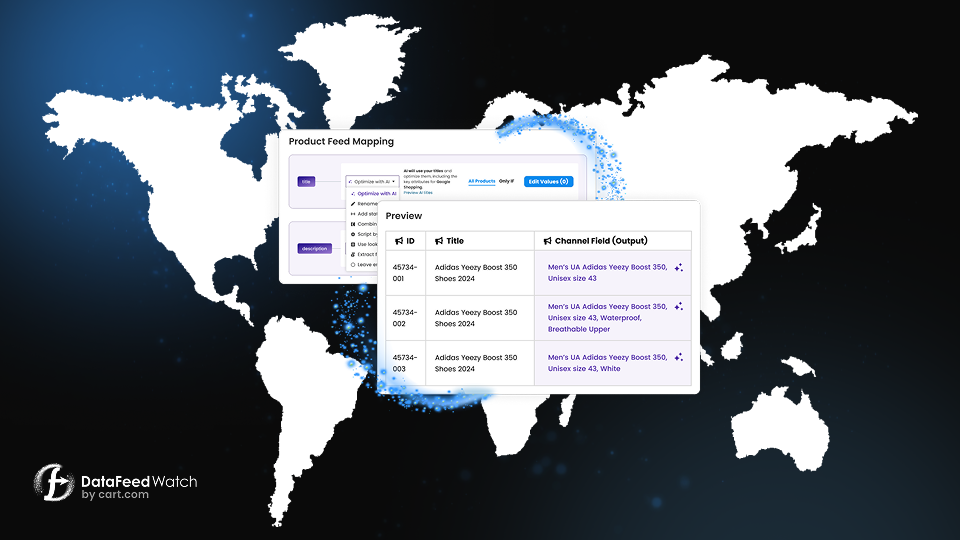
Expanding into new territories
If you don’t want to test new territories with your whole product catalog, you can translate your top-performing products into a new language. Then you can use the AI to optimize them for that specific market.
This allows you to test a new region with your most successful products, minimizing risk while gathering valuable performance data. Once you see positive results, you can expand your localized catalog.
Optimizing languages you already sell in
For those already advertising in multiple languages, our AI offers a way to quickly elevate your campaigns. Start by optimizing all your product titles and descriptions across your different language feeds. This initial step can provide a significant performance lift.
From there, you can dive into deeper optimizations, such as creating custom labels for top products, enhancing images, or A/B testing different title variations to see what resonates most in each market.
Consider where you’re selling
Finally, always align your campaigns with local retail calendars and promotions. A major holiday or sales event in one country may not exist in another. Ensuring your product feed and ad campaigns are in sync with local events is key to maximizing relevance and driving sales.
Go global, stay local
The journey into global ecommerce is both exciting and complex. Success is no longer just about having a great product; it's about effectively presenting your products with clear, high-quality data tailored to the needs of each advertising platform. As we've explored, optimized product feeds are the backbone of successful international advertising strategies. They improve ad relevance, boost performance, and build crucial trust with customers.
Expanding to 10 supported languages is just one step in our ongoing mission to simplify ecommerce for sellers everywhere. We are committed to continuing our innovation, with plans for even more languages and advanced features on the horizon.
Are you ready to unlock your global potential and save countless hours on feed management? Take the next step and see the power of intelligent automation for yourself. Try DataFeedWatch’s AI-powered feed optimization today and discover how effortless it can be to create high-performing product feeds for any market.
