Through strategic adjustments based on data analysis, we achieved a remarkable 25% increase in ROAS, highlighting the effectiveness of A/B testing titles in optimizing marketing efforts.
About Socium Media
We’re Socium Media, an award-winning performance marketing agency that helps mid-to-large-sized companies grow their business. Founded in 2019, we have a proven track record of launching highly successful performance marketing campaigns within paid search, paid social, search engine optimization (SEO), shopping, and feeds.As a forward-thinking agency, we’re constantly looking for new strategies to test to ensure we’re driving the most robust performance for our clients. For this case study, we'll focus on one of our fashion industry clients.
About the Client
Known for their playful-yet-sophisticated designs, this fashion brand was founded in NYC in the early 2000s. During the early days of the COVID-19 pandemic, they soared as their fashionable designs captured attention across the globe.

Problem
With most of their target audience/consumers shopping online, our client had a need we could confidently fulfill: improving Google Shopping campaign ROAS (return on ad spend).
To discover areas where Socium Media could make these improvements, we started by running a thorough analysis of their current Google Shopping campaigns.
Our analysis found that shopping titles began with the brand name, which took up valuable product title spaces. Although it can vary, Google Shopping Ads often have a max character count of 50, but only approximately 23 are shown in a Shopping ad on initial page load. By including the brand name at the title's beginning, 12 fewer characters could be utilized for high targeted keywords. Not only did we suspect that this was causing efficiency issues due to character limits, but we also speculated that the brand name keywords were receiving most of the keyword weight due to being displayed first on the shopping ads.
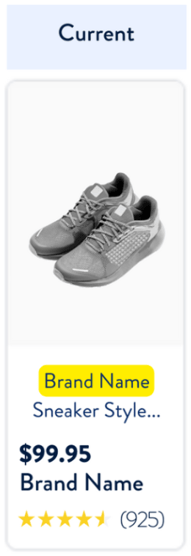
Including the brand at the beginning of the shopping ad isn't always a bad thing, as some shoppers could be explicitly looking for this particular brand shoes. However, it could also result in a lower conversion rate since high-intent keywords, such as keywords containing the name of the specific item’s style, might not have triggered the most relevant Shopping ads.
Solution
Thankfully, DataFeedWatch offers an A/B title testing functionality, so we could quickly run two different variations of product titles across our client’s shopping campaigns.
To test our hypothesis about whether or not the location of the brand name within the product title was contributing to a less efficient ad, we created two variations of product titles. Variation A included the brand name at the beginning of the product title (which is how it was initially set up), and variation B had the brand name at the end. 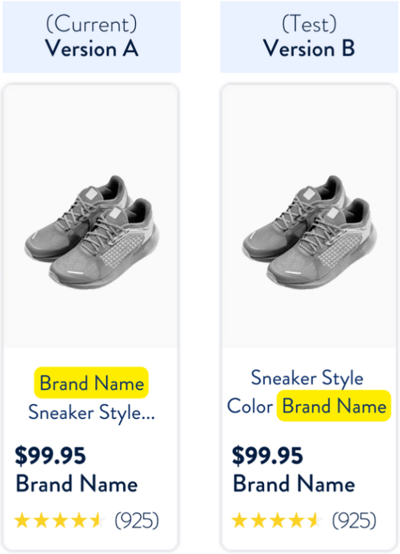
Product title examples:
- Title (Variation A): [Brand Name] [Style, Color] Sneakers | Size 9
- Title (Variation B): [Style, Color] Sneakers by [Brand Name] | Size 9
Utilizing DataFeedWatch's A/B test functionality for the title attribute, we were able to submit both variations of the title directly into the Google Shopping feed. DataFeedWatch then dynamically segmented traffic to serve one of the two versions of the title and automatically created unique parameters for both versions, allowing us to see the live performance within Google Analytics.To guarantee this was a fair A/B test, we didn't make any other changes to other key product attributes in the SERP PLA, such as image, brand name, product rating, etc.
Results
We ran this A/B test for 30 days to ensure we gave it enough time to exit the learning phase and gather valuable, actionable insights.
A/B tests often take several weeks to collect data and highlight any statistical significance, but within 11 days, we began seeing promising results within Google Analytics. When compared to version A, version B (the test that included the brand name at the end of the product title) showed a 41% increase in ROAS (return on ad spend) and a 12.5% increase in CTR (clickthrough rate). To see these results within such a short period assured us that we were on the right track!
 Three weeks after launching the A/B test, we saw Version A (original title with the brand name in the beginning) producing more revenue than Version B. Although the revenue volume was higher for Version A, Version B continued to align with our original goal—maintaining a 40% higher ROAS.
 By the end of our 30-day A/B test, we were pleased to see our hypothesis check out to be true! Version B, the product titles with the brand name at the end, proved to be more efficient ads, landing at a 25% higher ROAS and 10% lower CPC (cost per click).

Final Thoughts
Ultimately, this A/B test highlighted the strengths and weaknesses of brand name placement in Google Shopping product titles. The main takeaways were that for this particular fashion brand, moving the brand name to the end of the title allowed for a better CPC, CTR, and overall ROAS. We've incorporated these findings into their future Google Shopping campaigns and many other Socium Media clients.
Within one day, we identified an area for improvement, created an A/B campaign to test our hypothesis, and launched it using DataFeedWatch. “With as many SKUs as our client had, it wouldn’t have been possible to run an A/B test like this without DataFeedWatch,” said Allie Salvatore, Associate Director of Socium Media’s Shopping & Feeds division.
“Echoing what Allie said, DataFeedWatch 100% made this test possible,” shared Kevin Lee, Director of Socium Media’s Shopping & Feeds division.
